

Blog
Natural Agate Ring for Men: Styles & Meaning Guide

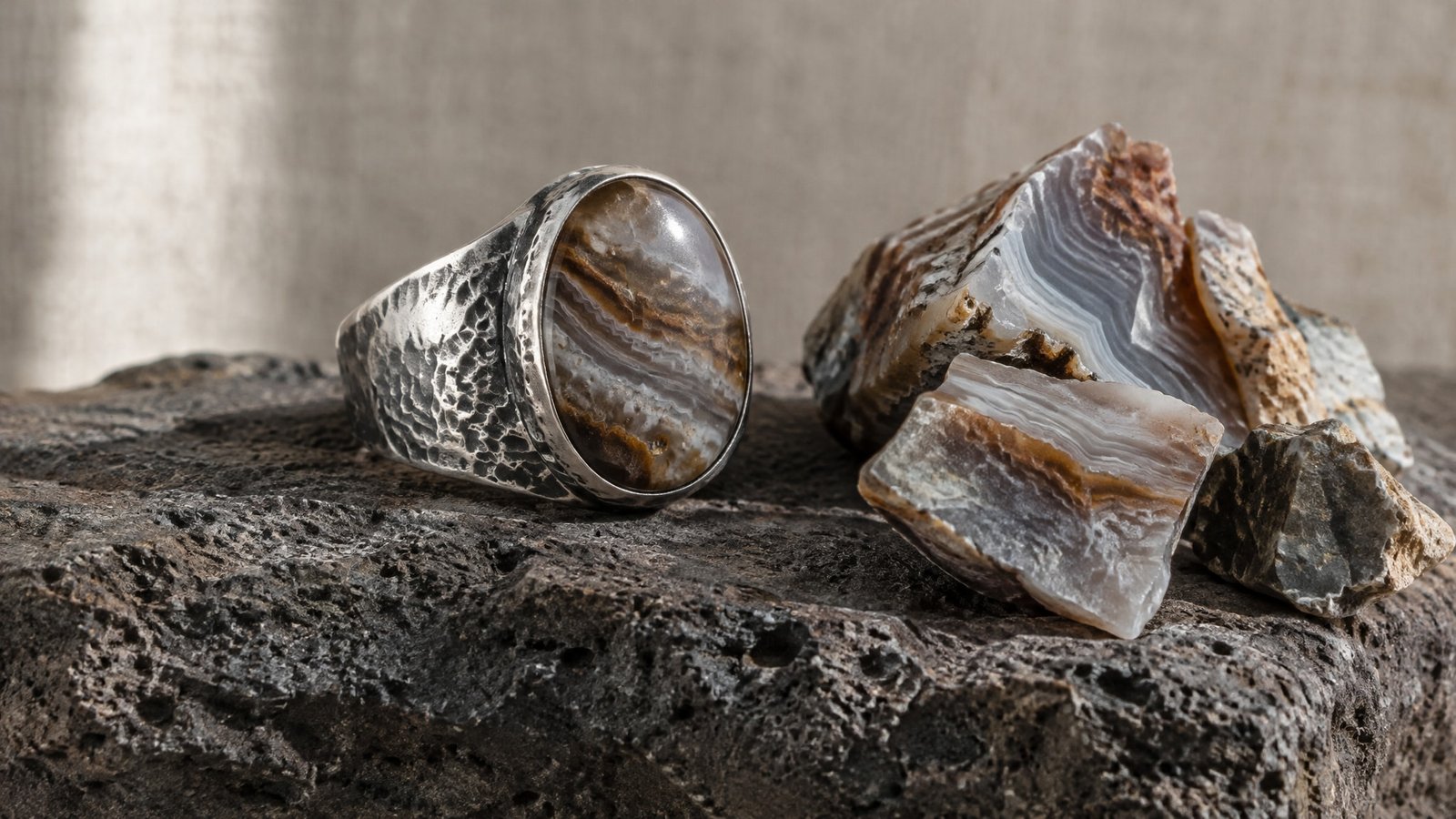
Shopping for a natural agate ring for men is harder than it looks. The names overlap, the colors vary wildly, and a good deal of “agate” on the market has been dyed or isn’t agate at all.
This guide sorts out what the words mean, how to question a seller, and which style fits your hand and your wardrobe. It then walks through six handmade 925 sterling silver rings from Katre Silver, part of Besen Jewelry Co. a Turkish jewelry business founded in 1995. Sizing and care come last, because both decide whether you’ll still enjoy the ring in ten years.
What Makes an Agate Ring for Men Natural
Agate is banded chalcedony, a fine-grained form of quartz that forms in nature, often inside cavities in volcanic rock. The bands build up layer by layer as mineral-rich water deposits silica, which is why no two stones have quite the same pattern.
“Natural” describes where the stone formed, not what happened to its color afterward. A stone can be entirely natural and still have been dyed, which is common in agate and not a problem as long as the seller says so.
Natural also doesn’t mean flawless. If you want a stone that looks as if nobody has ever touched it, agate is the wrong material, because irregular banding and small inclusions are what make it agate.
Agate, Aqeeq and Carnelian: Reading the Names
“Aqeeq” is the traditional name, used across Arabic, Persian and Turkish-speaking cultures, for agate and related red or banded stones. It’s a family label rather than a single mineral, so two rings sold as aqeeq can carry different stones.
The Powerful Yemeni Aqeeq Ring for Men shows this clearly. It’s set with a large red carnelian, a chalcedony relative of agate rather than agate itself. Carnelian is the same family of stone, usually without the strong banding.
None of the six rings compared below is listed as banded agate. If you’re set on that specific stone, go by the stone named on each product page, not by the word “aqeeq” in a title.
Telling Natural Agate From Dyed and Imitation Stone
Dyeing is a standard treatment for agate. Pale stone takes color well, and plenty of vivid blues, greens and purples you see in jewelry started life as gray or white banded chalcedony. Dyed agate is perfectly acceptable when the seller discloses it, and the trouble starts only when the listing stays silent.
Signs of Dye, Treatment and Imitation
You can’t confirm anything with certainty from photos, but several signs justify a question before you pay.
- Uniform or neon color. Natural color shifts across a stone. Saturated, even color in shades that rarely occur in nature, such as electric blue or hot pink, usually points to dye.
- Dye in surface cracks. If color pools darker along tiny fractures, the stone was likely colored after it formed.
- Glass-like bubbles. Round bubbles visible under magnification suggest glass rather than chalcedony.
- Patterns that repeat too neatly. Natural bands wander and vary from one to the next, so an evenly repeated pattern, especially across several stones in a set, deserves a closer look.
Moss-like or feathery inclusions are not a warning sign. They’re mineral growth inside the stone, often green or brown, and they’re among the features collectors of natural agate look for.
What to Ask a Seller Before You Buy
A reputable seller can answer four things in a sentence each, and you’re entitled to ask:
- The name of the stone, stated as specifically as possible (carnelian, agate, amber).
- Any treatment it has received, including dye.
- Confirmation that the band is 925 sterling silver.
- Photos that show the stone itself, not only styled shots.
Price is one clue among several, not a verdict. A very low price on a large, richly colored stone deserves a question, but a high price doesn’t prove authenticity either. If you want the longer explanation, here’s why gemstone ring prices vary from stone to stone.
Agate Ring Styles for Men: Signet, Statement and Gemstone Designs
Most men’s stone rings fall into two camps, and knowing which one you want narrows the search quickly. A signet has a flat face and a compact profile, while a statement or gemstone ring puts a larger stone front and center.
The Agate Signet Ring and Its Flat Face
A signet ring has a flat face that can hold an engraving, a monogram or a flat-cut stone. An agate signet ring is therefore a design choice and a stone choice at once: you get the signet’s tidy silhouette with banded or colored chalcedony as the face.
Signets suit everyday wear. The low, flat profile snags less on sleeves and pockets than a tall, domed setting, and it looks natural with a watch or a plain wedding band. If you’re weighing signets against one another, the men’s sterling silver signet ring guide covers face shapes, engraving and fit in more detail.
Statement Stones for a Bolder Look
A statement ring carries a larger stone, often with a raised setting, and the stone does most of the talking. It suits someone who wants a ring that draws a glance across a table, and it pairs well with plain clothes.
Three details change how any of these rings wears:
- Band width. A broad band looks substantial and sits more firmly on the hand, but it can feel snug and often calls for a slightly larger size.
- Stone color. Deep red, brown and blue stones read as classic and masculine, while lighter or more translucent stones look softer.
- Stone size. A bigger stone gives presence and also more surface to catch on a cuff or a glove, so think about how you actually spend your day.
What an Agate Ring Means for Men
Agate and aqeeq have been worn for centuries, and the associations that follow them are cultural and personal rather than scientific. The most common are strength, protection and steadiness, and for many wearers the stone also marks something private: a family inheritance, a gift from a father, or a milestone.
Aqeeq rings hold a long and respected place in Islamic and Middle Eastern tradition, where a stone ring is often chosen as much for its meaning as for its look. Customs differ widely by tradition and by family, including which hand, which finger and which stone people prefer, so if the ring matters religiously or ceremonially, ask the people whose practice you’re following.
The product copy for the Powerful Yemeni Aqeeq Ring for Men frames the piece around strength, tradition and masculine elegance. That’s a fair way to talk about meaning, and none of it is a medical claim or a promise about what a stone will do for you.
Katre Silver’s Natural-Stone Rings for Men, Compared
All six rings below are handmade in 925 sterling silver, and the prices are approximate, so check each product page for the current figure. They’re sorted by style rather than by price.
Signet-Style Picks: Aqeeq, Amber and Crown Designs
The Powerful Yemeni Aqeeq Ring for Men comes first because it carries the name many readers search for. It’s built around a large red carnelian and costs around $295. It’s the most traditional of the group and the one to choose if aqeeq tradition is the point of the purchase.
The Baltic Amber Ring Silver 925 takes a warmer direction, with natural Baltic amber in an Ottoman-style, vintage-feeling setting, at around $174. Amber is a fossilized tree resin that formed millions of years ago, so the stone has a glow that mineral stones don’t. It’s lighter in feel than it looks, but it’s also the one that needs the most careful handling.
The Best Golden Rutile Quartz Ring for Men, at around $275, uses a crown design and a natural quartz with golden needle-like inclusions. Those fine golden lines are what you’re paying for, and they catch light differently as the ring moves.
Statement Gemstone Picks and a Gift Pairing
The Best Blue Kyanite Ring for Men is listed as a gemstone ring rather than a signet. Kyanite is known for its deep blue color and distinctive crystal structure, and the ring costs around $165. It’s the pick for someone who wants blue without going to sapphire territory.
The Best Amethyst Ring for Men is a purple stone in an Ottoman-style, Turkish-made statement setting, and at around $115 it’s the most accessible ring here.
For a gift pairing, the Best Natural Colombian Emerald Ring is labeled as a gift for her. It features a natural green Colombian emerald in a vintage-style silver setting, at around $275. If you’re buying for a couple, it sits well beside the aqeeq or amber ring, though it’s designed with a woman wearer in mind, so it isn’t the right choice for a man’s ring.
Choosing the Right Ring Size
Guessing is the most common reason a ring ends up in a drawer. A finger that measures one size in the morning can measure a half size larger by evening, so take your measurement at the end of the day, when you’re warm and your hands aren’t cold.
If you own a ring that already fits well on the same finger, that’s even better. Measure its inside diameter, or compare it against a size chart, and use that as your starting point. A string or paper strip wrapped around the finger works too, but it’s the least precise method.
Every ring in this guide is listed in whole and half sizes from 6 to 13. You’ll find the full list on each product page.
A wide band covers more of the finger and fits more tightly than a thin one at the same nominal size, so a half size up often suits wider bands. If you’re between sizes and the ring is chunky, go up.
Caring for Your Silver and Stone Ring
Sterling silver is gentle work. Wipe the ring with a soft, dry cloth after wearing it to lift skin oils before they dull the metal, and store it separately from other jewelry so harder stones don’t scratch it. You’ll also want to take the ring off before cleaning, swimming, or handling household chemicals.
Harsh chemicals such as bleach, chlorine and strong cleaners damage both the silver and many stones, so keep them away from your ring. Carnelian and other chalcedony are hardy, but a ring that touches a stone setting and a polished band still wears better with simple habits.
Why Amber Needs Gentler Care
Amber is a fossilized tree resin, not a mineral, which is why the Baltic Amber Ring Silver 925 deserves more caution than agate or carnelian. Resin is softer and reacts to things that chalcedony shrugs off.
Keep it away from heat, including hot water, saunas and a hot car dashboard. Solvents such as perfume, hairspray, alcohol and nail polish remover can cloud or damage the surface. Skip ultrasonic cleaners and steam, and stick to a soft damp cloth.
When you have your size and a care routine in hand, you can open the page for the Powerful Yemeni Aqeeq Ring for Men, or any of the other rings linked above, and read the stone details at your own pace.
Frequently asked questions
Is aqeeq the same as agate?
Not exactly. Aqeeq is a traditional name that covers agate and related red or banded stones, so it’s a family label rather than one mineral. The Powerful Yemeni Aqeeq Ring for Men, for example, is set with red carnelian, which is a chalcedony relative of agate. Check the stone named on the product page.
Is dyed agate fake?
No. Dyed agate is still natural agate that has been given color, and dyeing is a common, accepted treatment when it’s disclosed. It becomes a problem when a seller hides it or sells glass or plastic as stone. Ask for the stone’s name and any treatment in writing.
How do I know my agate ring is real?
Look for color that varies across the stone, bands that wander rather than repeat neatly, and no dye pooled in cracks or glass-like bubbles. Photos can’t prove it, so ask the seller to name the stone and state any treatment. Confirm the band is 925 sterling silver as well.
What size should I order if I’m between sizes?
Measure at the end of the day, then choose from the whole and half sizes listed on the product page, which run from 6 to 13. If the ring has a wide band, a half size up often fits better because wide bands sit more snugly on the finger.
Can I clean an amber ring the same way as a carnelian ring?
No. Carnelian is a hardy chalcedony, but amber is a fossilized tree resin and reacts to heat, solvents and ultrasonic cleaning. Use only a soft, slightly damp cloth on amber, and keep perfume, alcohol and nail polish remover away from it.